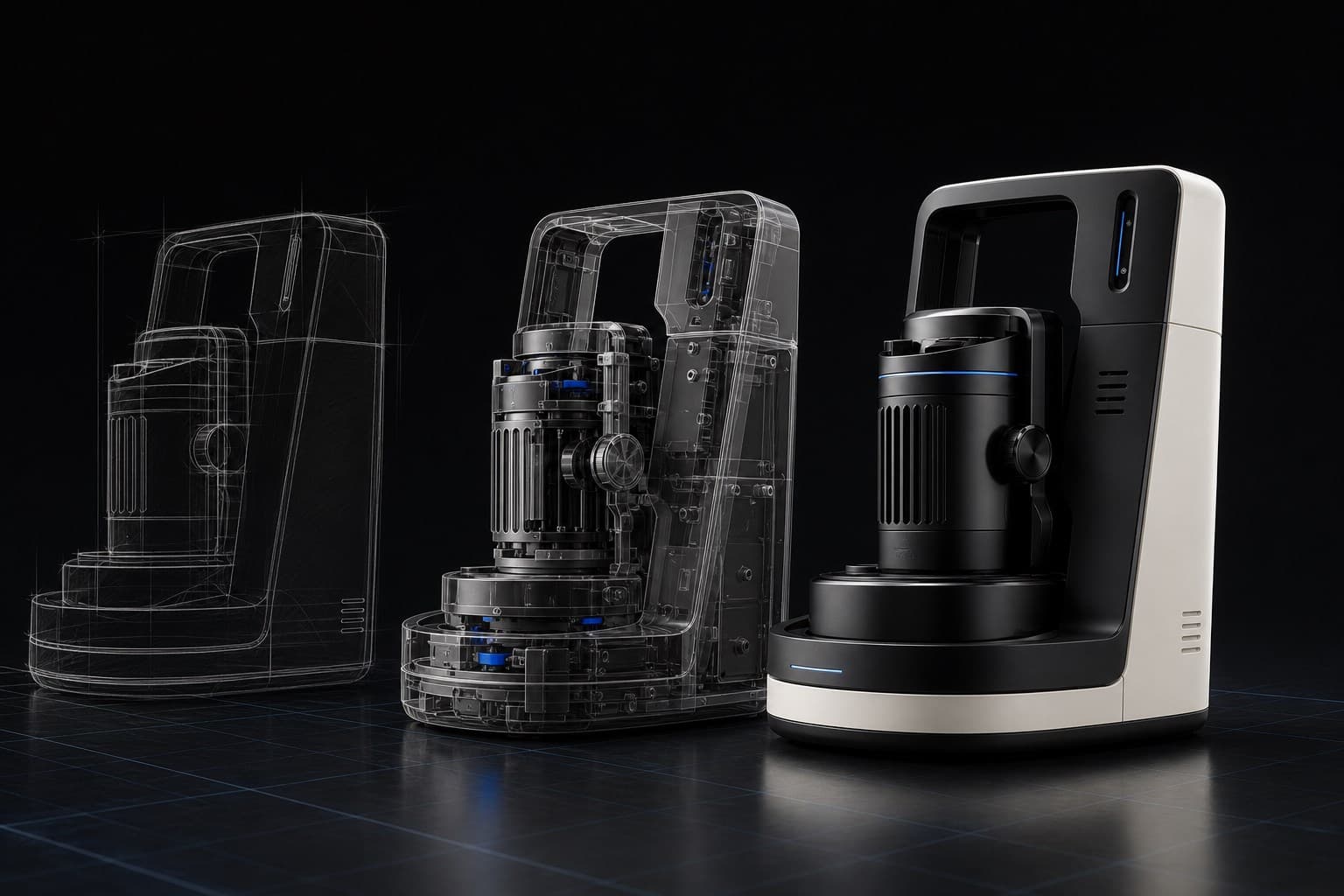
PROCESS / R&D process
Let R&D proceed in an orderly manner.
The process is not a fixed template, but a set of working methods used to clarify problems, reduce communication errors, and continuously verify judgments.
WORKING METHOD
Six stages
Answer one question at each stage.
Projects can be entered from different nodes, and there may be multiple round-trips. The role of phasing is to let the team always know what is currently being judged and what is needed next.
- 01DISCOVER
Requirements and boundaries
Clarify product purpose, users, functionality, dimensions, budget, and time boundaries.
- 02DEFINE
Direction and strategy
Establish design keywords, experience priorities, and key judgments that need to be verified.
- 03DESIGN
Form and interaction
advances appearance, surfaces, operations, and CMF, and continues convergence through stage reviews.
- 04ENGINEER
Structure and data
Synchronize internal layout, assembly relationships and process boundaries to form engineering data.
- 05VERIFY
Prototype and verification
Use renderings, 3D printing, or prototypes to examine scale, experience, and structural risks.
- 06DELIVER
Delivery and collaboration
Organize design and engineering data and connect subsequent proofing, adjustment and manufacturing communication.
PROJECT PATHFINDER
Project path judgment
Where should a project begin?
Select the closest current status to quickly see suggested communication paths.
Define the product and design simultaneously.
Suitable for teams that have market direction but have not yet formed a complete product solution.
- 01Requirements and boundaries
- 02Appearance direction
- 03Structural deepening
- 04Prototype validation
BEFORE WE START
Information before starting
Start with a clear goal.
Even if you only have one idea or one physical object for now, discuss the project boundaries first.
Describe your project- 01Product usage
To whom, and in what context.
- 02Current stage
Ideas, sketches, three-dimensional data, prototypes or actual objects.
- 03Critical boundaries
Size, devices, interfaces, materials, budget and time.
- 04Expected Delivery
Whether it is used for review, modification, proofing, demonstration or subsequent development.
START A PROJECT
Not sure where to start? Communicate first.
Explain the existing ideas, data or physical objects, and we will help determine the appropriate starting point.